Nonpartisan Analysts Projected Surpluses Through FY2028, Before And After Moore Took Office
The December 2022 Spending Affordability Committee Report Confirmed A Structural Surplus Through FY2028
- The Nonpartisan Spending Affordability Committee Projected Structural Surpluses Every Year Through FY2028. “The structural surplus is projected to exceed $1.0 billion from fiscal 2023 through 2025 before beginning to decrease due to the impacts of the investment loss on pension contributions in the out-years and the need for general funds to support costs related to the Blueprint for Maryland’s Future beginning in fiscal 2028. Even with these additional costs, however, the structural surplus remains greater than $600 million in fiscal 2028.” (Maryland Department of Legislative Services, Spending Affordability Committee 2022 Interim Report, December 16, 2022, p. 4)
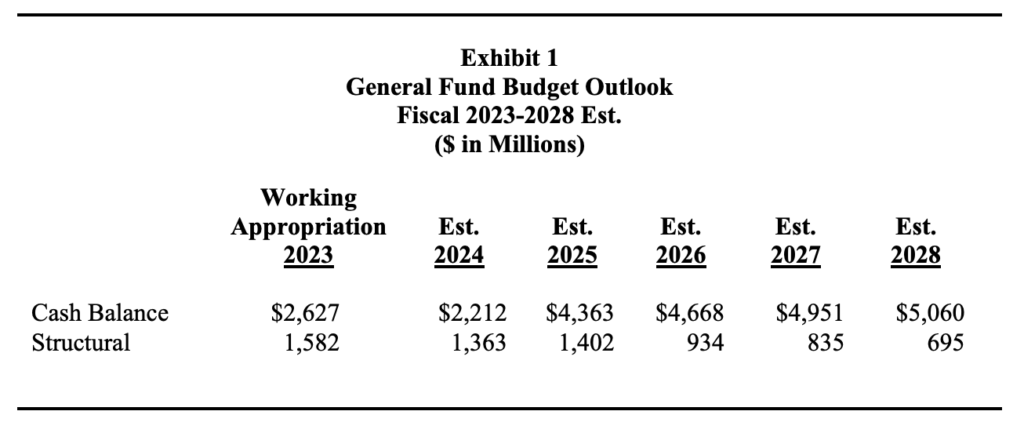
The Structural Surplus Was Projected As Follows Through FY2028 (Exhibit 1, Page 4):
FY2023: $1,582 million | FY2024: $1,363 million | FY2025: $1,402 million | FY2026: $934 million | FY2027: $835 million | FY2028: $695 million
(Maryland Department of Legislative Services, Spending Affordability Committee 2022 Interim Report, December 16, 2022, Exhibit 1, p. 4)
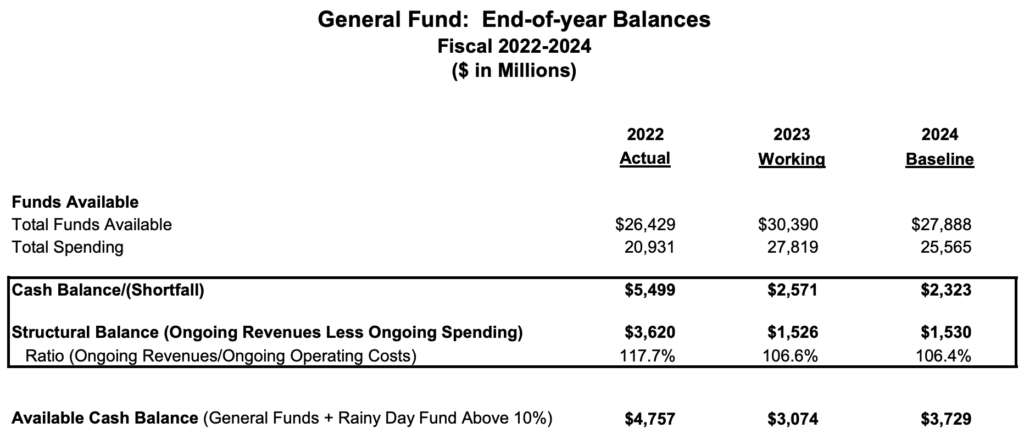
- Maryland’s Cash Balance At The Close Of FY2022 Was $5,499 Million ($5.5 Billion). The December 2022 Spending Affordability Committee report confirmed an ending general fund cash balance of $5,499 million at the close of fiscal year 2022. (Maryland Department of Legislative Services, Spending Affordability Committee 2022 Interim Report, December 16, 2022, p. 44)
- The Spending Affordability Committee Was Chaired By Democrat Senator Jim Rosapepe. The December 2022 report was published by a Democrat-chaired, nonpartisan legislative committee five weeks before Moore took office. (Maryland Department of Legislative Services, Spending Affordability Committee 2022 Interim Report, December 16, 2022, Cover Letter)
The Surplus Was Driven By Organic Tax Revenue Growth, Not Solely Federal COVID Funds
- The FY2022 Surplus Was Fueled Primarily By Record Organic Tax Revenue Growth. Maryland Comptroller Peter Franchot confirmed that personal income tax revenues came in 15.7% higher than projected, sales and use taxes increased 19.6%, and corporate income tax rose 16.3% — all organic Maryland tax revenues driven by economic activity, not federal transfers. (Maryland Matters, September 15, 2022)
- A Structural Surplus By Definition Already Strips Out One-Time Revenues. The Spending Affordability Committee’s structural surplus calculation measures ongoing revenues against ongoing spending — it explicitly excludes one-time or temporary revenue sources such as federal COVID aid. The committee projected structural surpluses through FY2028 with full knowledge that federal COVID assistance was temporary. A structural surplus that projected surpluses through FY2028 cannot logically be explained away as a product of one-time COVID money. (Maryland Department of Legislative Services, Spending Affordability Committee 2022 Interim Report, December 16, 2022, p. 4)
- The SAC Report Explicitly Attributed The Structural Surplus’s Future Decline To Blueprint Costs And Pension Obligations, Not Federal Aid Drying Up. The December 2022 report stated the structural surplus would decline in the out-years due to “the impacts of the investment loss on pension contributions in the out-years and the need for general funds to support costs related to the Blueprint for Maryland’s Future.” There is no mention of federal COVID aid as a factor in the projected decline. (Maryland Department of Legislative Services, Spending Affordability Committee 2022 Interim Report, December 16, 2022, p. 4)
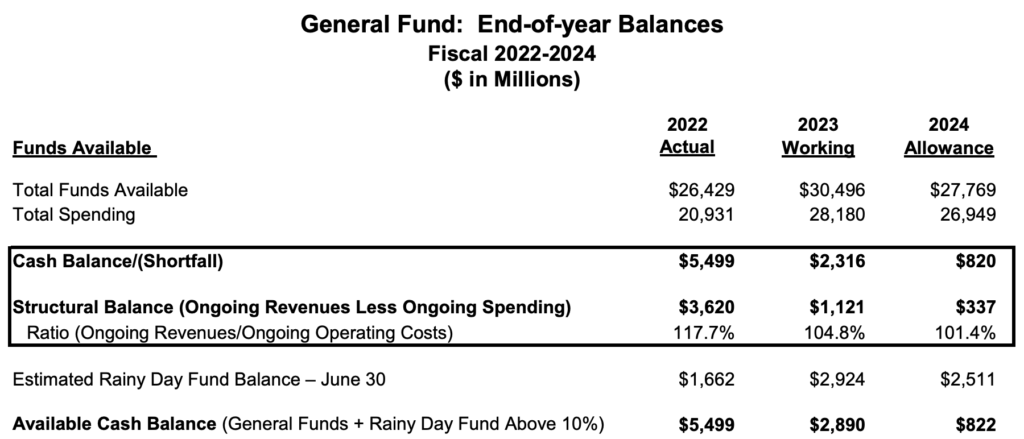
- Moore’s Own First Budget, Produced After Federal COVID Aid Had Substantially Wound Down, Still Showed A Structural Surplus. The January 25, 2023 DLS Fiscal Briefing, which analyzed Moore’s own first budget submitted seven days into his term, still projected a $337 million structural surplus for FY2024 and positive structural balances through FY2026. By January 2023, major federal COVID relief programs had already concluded or were winding down. If the surplus were solely a product of COVID funds, no structural surplus would have appeared in Moore’s own first budget analysis. (Maryland Department of Legislative Services, The Governor’s Fiscal 2024 Plan, January 25, 2023, p. 19)
- Maryland Closed FY2023 With A $555 Million Surplus Under Moore’s Own First Budget Year, With No COVID Funds Driving It. Democratic Comptroller Brooke Lierman confirmed Maryland closed fiscal year 2023 with a $555 million surplus. The closeout report noted this was driven by withholding income tax revenues that grew more than 5%. (Conduit Street, Maryland Association of Counties, September 18, 2023)
Moore’s Own First Budget, Analyzed By DLS Seven Days Into His Term, Still Showed A Structural Surplus
- DLS’s January 25, 2023 Fiscal Briefing, Produced Seven Days After Moore Took Office, Still Projected A $337 Million Structural Surplus For FY2024, Moore’s First Full Budget Year. The January 2023 DLS Fiscal Briefing analyzed Moore’s own first budget allowance submitted to the General Assembly. Even with Moore’s own budget factored in, DLS projected a positive structural balance of $337 million for FY2024. (Maryland Department of Legislative Services, The Governor’s Fiscal 2024 Plan, January 25, 2023, p. 19)
- The Structural Balance Only Turned Negative In FY2027, Due To Blueprint Costs. “An unexpected surge in the number of students qualifying for free and reduced-price meals is the primary reason for the deterioration in the sustainability of the Blueprint Fund,” adding $1.6 billion in additional compensatory education costs over five years. (Maryland Department of Legislative Services, The Governor’s Fiscal 2024 Plan, January 25, 2023, p. 4)
The January 2023 DLS Structural Balance Projections From FY2024 Through FY2028:
FY2024: +$337 million | FY2025: +$232 million | FY2026: +$263 million | FY2027: -$963 million | FY2028: -$1,207 million
(Maryland Department of Legislative Services, The Governor’s Fiscal 2024 Plan, January 25, 2023, p. 5)
- DLS Noted That Moore’s Budget Plan “Does Not Appear Sustainable Over The Long-Term.” Seven days into his term, DLS analyzed his first budget and stated the plan did not appear sustainable over the long-term. (Maryland Department of Legislative Services, The Governor’s Fiscal 2024 Plan, January 25, 2023, p. 5)
Moore’s Statements On The Surplus And Deficit
- January 2023: Moore Called Maryland’s Fiscal Position “Fortunate.” In a letter to legislative leaders dated January 2023, Moore said “we are in a fortunate financial position.” (Governor Wes Moore, Letter to Legislative Leaders, January 2023; Spotlight on Maryland, Fox45 News, May 6, 2026)
- January 2025: Moore Said He Inherited A Structural Deficit. “I inherited a structural deficit when I became the governor because the state was both spending at a clip that was not sustainable, and we were growing at a clip that was embarrassing.” (CBS News Baltimore, January 14, 2025)
- January 2025: Moore Said The State “Did Not Inherit A Structural Surplus.” “Let’s be clear, we did not inherit a structural surplus. COVID money is not a structural surplus. Billions of dollars that came into the state did not represent a structural surplus in any way, shape or form. It basically was just one-time money.” (Fox45 News, January 16, 2025)
- April 2025: Moore Said He “Walked Into This Session Dealing With An Inherited Structural Deficit.” “I would say we walked into this session dealing with an inherited structural deficit and we are going to leave session with a surplus.” (Fox45/WBFF News, April 8, 2025)
- 2025: Moore Said The Surplus “Wasn’t Real.” Moore stated the surplus “wasn’t real” because of one-time federal COVID funds. This is directly contradicted by the nonpartisan December 2022 Spending Affordability Committee’s structural surplus projections through FY2028 and Moore’s own January 2023 letter calling the state’s fiscal position “fortunate.” (Spotlight on Maryland, Fox45 News, May 6, 2026)
Current Fiscal Outlook: Structural Deficits Through FY2031
- The April 2026 DLS 90-Day Report Projects Structural Deficits Through FY2031, After The Largest Tax And Fee Hike In State History. DLS confirmed structural deficits of $598 million in FY2027, growing to $2.573 billion in FY2028, $2.853 billion in FY2029, $3.429 billion in FY2030, and $3.353 billion in FY2031, following a $1.68 billion tax and fee package and $803 million in spending cuts. (Maryland Department of Legislative Services, 90-Day Report, April 2026, Exhibit A-1.7, p. A-17)
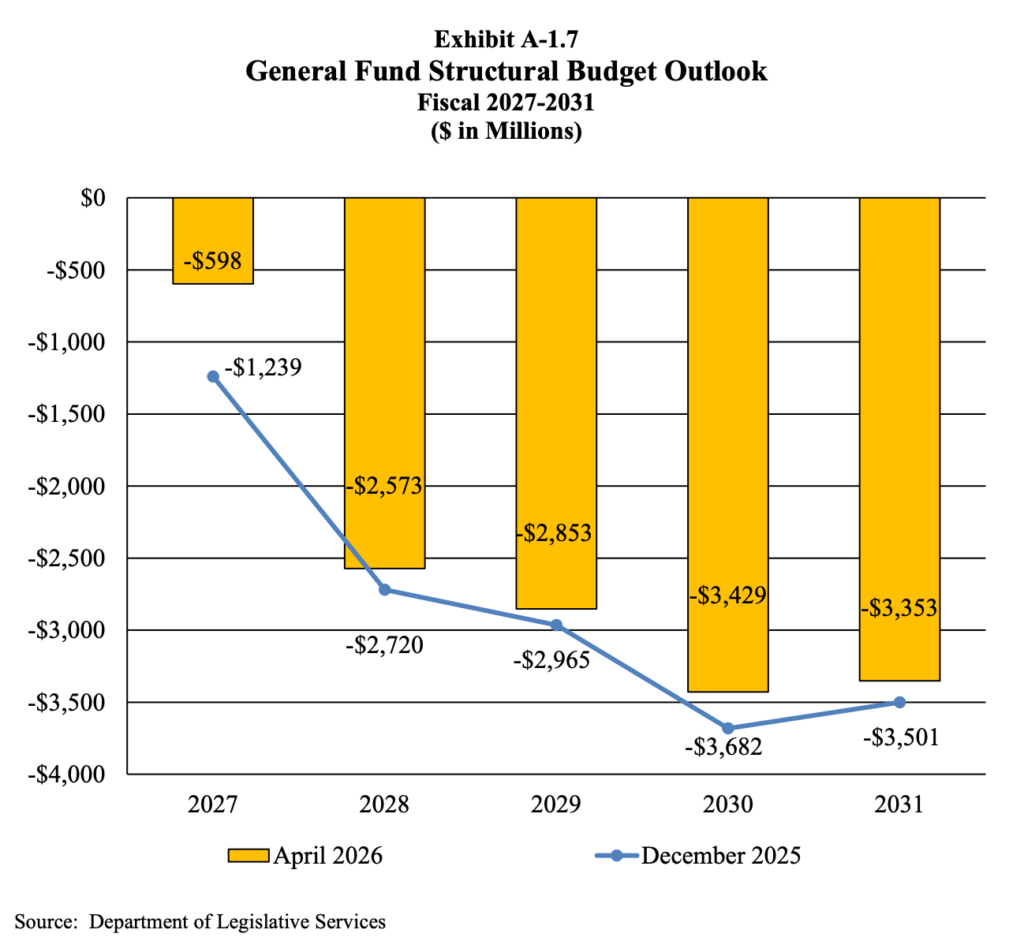
All figures sourced directly from nonpartisan Maryland Department of Legislative Services primary documents and verified news sources. Sources available upon request.